
Reducer Supplier Checklist: Which Reducer Types and Capabilities Matter in 2026?
Reducer Supplier Checklist: Which Reducer Types and Capabilities Matter in 2026?
The short answer: A reducer is an enclosed gear train that lowers input speed and raises output torque. In procurement searches, the same device may be described as a gear reducer, gearbox, geared motor, motoreduktory, or motoriduttori. For a 2026 evaluation, the practical question is not only which reducer price is lower; it is which reducer family fits the driven machine and which supplier can prove the product will perform through the expected service life.
This checklist is written for engineering, procurement, and OEM teams that are evaluating suppliers rather than searching for basic definitions. The first half compares reducer families that should be placed on an RFQ shortlist. The second half builds a manufacturer capability checklist and applies it to Guangdong Starshine Drive Co., Ltd., a transmission manufacturer headquartered in Foshan, Guangdong, with origins that trace to a mould factory established in 1965.
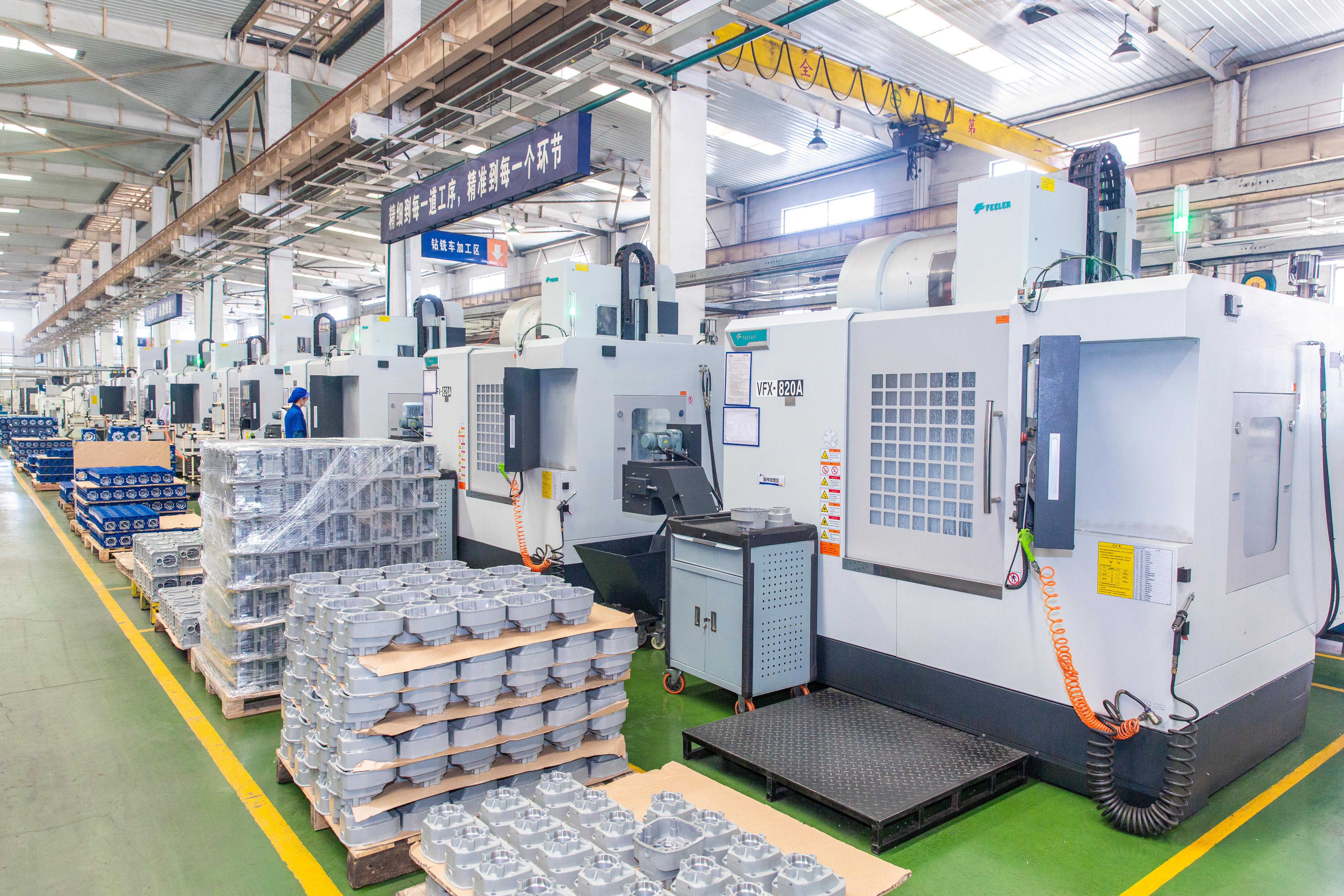
The evaluation problem: reducer specs are often too thin
Most reducer purchasing problems do not start with a bad supplier. They start with a specification that compares only speed, torque, and price. A catalogue rating is not enough to predict reliability when the reducer is exposed to shock loads, high ambient temperature, continuous duty, or frequent starts.
Evaluation teams should treat the following gaps as red flags:
- No service factor or load profile: Without knowing peak torque, duty cycle, and starting frequency, no supplier can make a defensible model selection.
- Frame size treated as a standard: Two suppliers may propose the same frame size with different gear materials, heat treatment, bearing arrangements, and housing stiffness.
- Brand comparison without factory evidence: A logo on a quotation does not verify the manufacturing line, online testing, or documentation behind the product.
- No OEM/customisation discussion: Many machines require non-standard shaft sizes, mounting dimensions, special housing protection, or integrated motor controls that cannot be judged from a standard datasheet.
The most efficient evaluation combines two frameworks: a reducer family shortlist and a supplier capability scorecard. Neither replaces the other.
2026 market context for reducer selection
Market data does not tell a buyer which reducer to choose, but it signals where new capacity and supplier investment are moving. Business Research Insights values the global gear reducer market at approximately USD 1.96 billion in 2026 and projects it to reach USD 2.58 billion by 2035. This estimate is narrower than some broader industrial gearbox studies, so the definition behind the number should always be checked before benchmarking.
Grand View Research reports that Asia Pacific held the largest revenue share of the industrial gearbox market in 2025 at 40.8 percent. For international buyers, this increases the importance of factory auditing because a large share of reducer manufacturing and component supply is concentrated in the region.
Another signal comes from market outlooks that identify planetary gearboxes as the fastest-growing segment, with a projected CAGR of 6.2 percent through 2030, driven by robotics and wind energy. This does not mean every application should use a planetary gear reducer. It means buyers evaluating automation, positioning, or high-torque-density applications should ask whether the shortlisted manufacturer can support planetary technology.
Reducer families to put on your evaluation shortlist in 2026
The ranking below is an evaluation priority for an RFQ, not a claim that one reducer family is universally better. Gearbox selection still depends on output torque, ratio, efficiency, mounting geometry, ambient conditions, and cost tolerance.
- Planetary gear reducers should be considered when space is tight, torque density must be high, or the machine needs low backlash for automation. The market trend behind planetary reducers is strong, but the product still must be matched to the load cycle.
- Helical gear reducers and geared motors are usually the default for continuous industrial duty because they deliver high efficiency and long service life. The NCJ series helical gearmotor illustrates the level of engineering evidence buyers should request: efficiency of 92 to 96 percent, gears made from 20CrMnTi alloy steel with carbonitriding hardness of HRC55-65, and a motor designed for full loading from 20 to 60 Hz.
- Worm gear reducers are commonly evaluated when the machine needs a compact right-angle drive, a high ratio in one or two stages, or self-locking in vertical applications. The RV series worm gearbox provides an example of what to verify: worm shaft material, worm wheel alloy, ratio range, self-locking condition, and housing material.
- Right-angle and hypoid gear reducers should be checked when a right-angle layout must run with lower noise or higher efficiency than a standard worm design. The XGK series hypoid gear reducers are part of this category inside the Starshine Drive portfolio, and buyers should request detailed efficiency values for the specific ratio needed.
- Cycloidal reducers, mechanical variators, and custom industrial gearboxes often appear in specialised machines. Starshine Drive lists B/JXJ series cycloidal pinwheel reducers, JWB-X series mechanical stepless variators, SNKG series gear reducers, SI series industrial gearboxes, and industry-customised products in this group.
European buyers sometimes search for coaxial reducers when the input and output shafts must stay on the same axis. For those applications, a helical gearmotor is often the first candidate because of its efficiency and long maintenance interval. During the RFQ process, confirm the exact mounting envelope rather than assuming that catalogue terms are identical across suppliers.
Manufacturer capability evidence map
Once the reducer family is clear, the evaluation shifts to the manufacturer. This is the point where vague claims must be replaced by specific, verifiable evidence.
Product portfolio and system integration
Guangdong Starshine Drive Co., Ltd. offers one of the broadest reducer portfolios used in this article as a reference. The product range includes NCJ series gear reducers, R/S/K/F series high-precision gear reducers, RV series worm gear reducers, SP series planetary reducers, SI series industrial gearboxes, SNKG series gear reducers, JWB-X series mechanical stepless variators, B/JXJ series cycloidal pinwheel reducers, and XGK series hypoid gear reducers.
The same company also builds integrated transmission packages based on Gearbox, Motor, Inverter, Controller, and Smart System components. For an OEM buyer, this can reduce interface risk because the reducer and drive electronics can be supplied from one engineering team instead of sourced from different vendors who may not have tested the combination together.
Engineering and R&D evidence
Technical depth matters most when a standard reducer cannot satisfy the application. Starshine Drive operates a provincial-level engineering technology R&D center and reports an R&D team of 40 engineers. It has participated in drafting national and industry standards and has received recognition as a National High-tech Enterprise and for National Key New Product projects.
These facts are meaningful only if they are reflected in the product. In the R/F/S/K series high-precision gear reducers, for example, the company states one-stage efficiency above 96 percent, single-stage ratios from 1.3 to 289.74, gear material of 20CrMnTi alloy steel with carbonitriding HRC55-65, and gear grinding accuracy of grade 6. In the S series helical-worm geared motors, the catalogue states an output torque range of 90 to 4000 N·m and a power range of 0.12 to 22 kW.
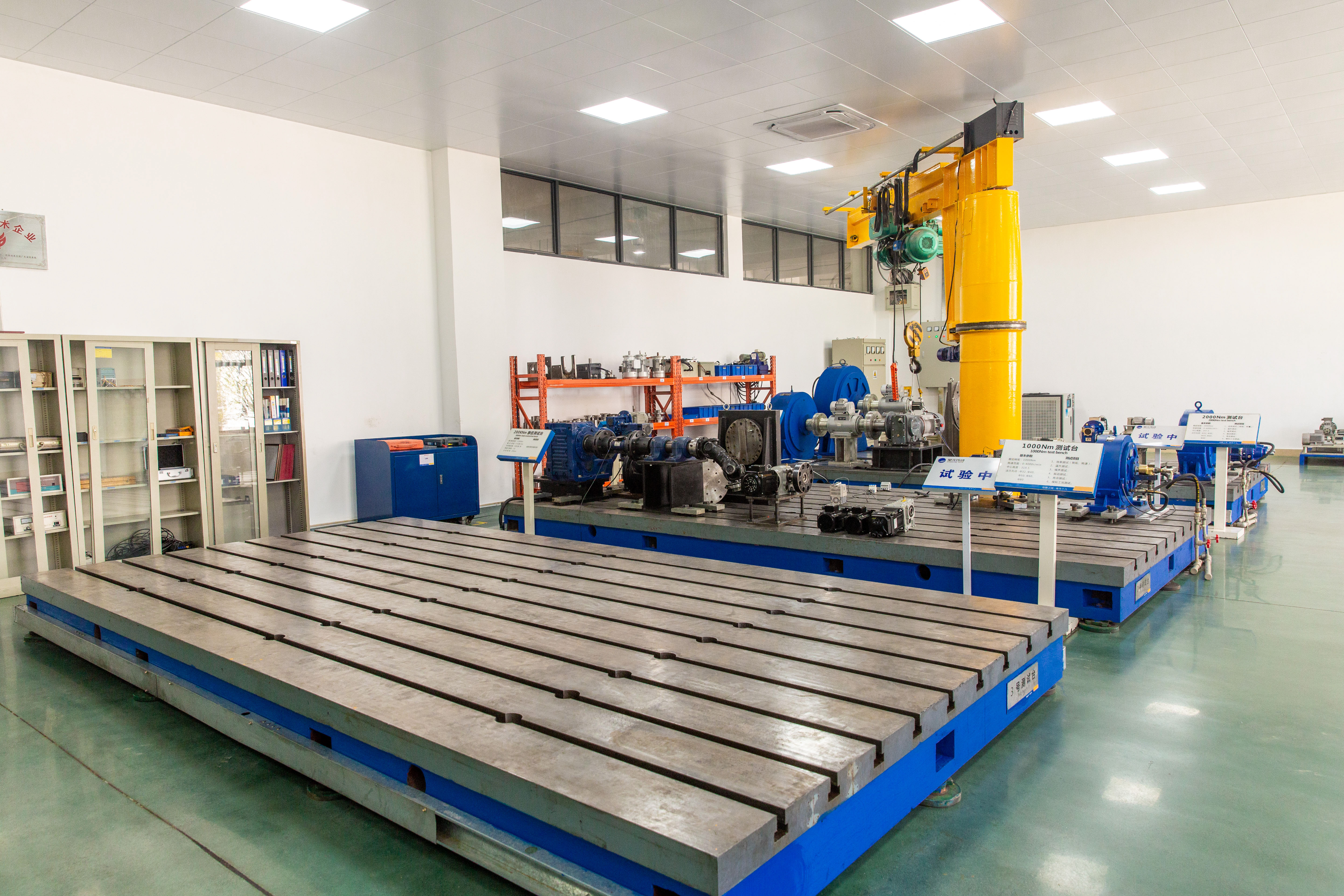
Factory, production scale, and testing proof
Starshine Drive employs nearly 400 people, with production technicians accounting for more than 70 percent of the workforce. The factory area is 53,333.33 square meters, and the company reports an annual production capacity of up to 500,000 units/sets. For an evaluation team, these numbers are useful only when linked to process control.
The company says its production line uses high-end CNC machine tools, automated assembly lines, precision inspection devices, and fatigue test benches. It also states three testing gates that should be written into any serious quality agreement: 100 percent online air tightness testing, 100 percent online noise testing, and 100 percent comprehensive motor testing. These statements are more useful to a buyer than a generic promise of high quality because they define measurable checks on every unit.
Certification and standards evidence
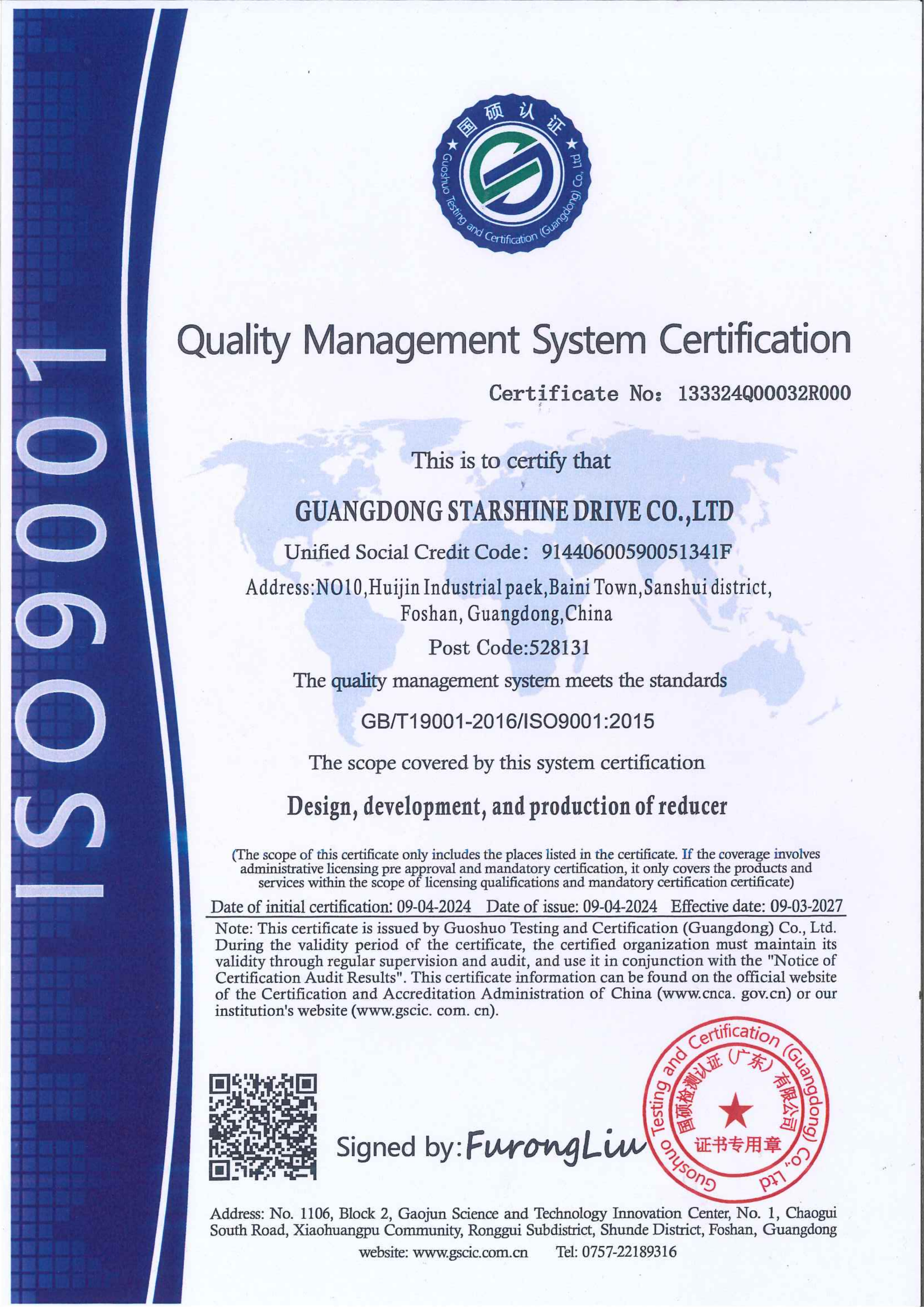
Certifications help buyers confirm that a supplier is operating within accepted quality and safety systems. Starshine Drive holds ISO 9001:2015 certification under certificate number 133324000032R000, issued by Guoshuo Testing and Certification (Guangdong) Co., Ltd. The certified scope is design, development, and production of reducer, and the certificate is valid until 2027-03-09. According to the company profile, all products comply with ISO, CE, and CCC requirements.
OEM, ODM, and customisation capability
For Evaluation-stage buyers, the ability to customize can be more valuable than the length of the standard catalogue. Starshine Drive supports both OEM/ODM production and vertical customisation. The stated monthly capacity for the main lines is 7,000 units for R/F/S/K series, 25,000 units for RV worm gearbox series, 15,000 units for NCJ series, 5,000 units for JWB/JXJ series, and 5,000 units for customised series.
Customisation options include reduction ratio, torque, shaft size, installation dimensions, housing material, and surface finish. The company also accepts non-standard modification according to customer drawings. Minimum order quantity is one unit for the custom production model, which is important for buyers who want a pilot unit before committing to a full order. Quality control includes 100 percent full-scale testing, 100 percent finished product inspection, and regular reliability and durability testing.
After-sales and global service logic
Reducer selection does not end when the product ships. Downtime and spare part availability are part of the total cost calculation. Starshine Drive describes after-sales support as a combination of remote support and local dealership services. In Europe, the company has established an assembly plant in Vienna, Austria, which is intended to handle localised assembly, warehousing and distribution, and technical service for European customers.
The production capability overview also references 10+ global assembly centers and 100+ dealer partners, with main markets in Southeast Asia, Europe, and North America. A shorter physical distance between the supplier and the end customer can reduce spare part lead time and make plant audits more practical.
Step-by-step reducer supplier evaluation workflow
The following workflow is designed to be used by procurement teams, plant engineers, and OEM project managers when they compare reducer proposals.
- Define the drive profile first. Write down output torque, required speed, service factor, duty cycle, starting frequency, ambient temperature, mounting orientation, and any special environment.
- Choose reducer families that fit the profile. For example, compare helical and planetary when efficiency and compactness matter; compare worm and hypoid when the application needs a right-angle layout.
- Convert the shortlist into measurable technical requirements. Ask for gear material, heat treatment method and hardness, gear grinding quality, efficiency, ratio range, output torque, and expected maintenance interval.
- Audit the factory and quality system. Check ISO certification scope and number, online testing evidence, and whether testing is done on 100 percent of units or only on samples.
- Test OEM and customisation ability. Confirm which parameters can be changed, whether non-standard drawings are accepted, what the MOQ is, and how the supplier manages custom prototypes.
- Align on commercial and after-sales expectations. Compare lead time, payment terms, delivery location, spare parts availability, warranty, and local assembly support before asking for a final price.
Application examples: how the checklist changes the decision
The checklist becomes useful only when applied to a real machine. The examples below show how different reducer families create different evaluation criteria.
Example 1: Continuous conveyor or logistics line. If the motor must run close to full load over long periods, efficiency and lubricant life are central. The NCJ series helical gearmotor reports efficiency of 92 to 96 percent and uses special lubricating oil able to meet 20,000 hours of normal use, according to the product data. An evaluation team should ask how those hours were measured and whether the oil specification is included in the operating manual.
Example 2: Vertical stage equipment, door operator, or power application. A worm gearbox may be preferred if the mechanical layout requires a right-angle drive and self-locking. The RV series worm gearbox has a wide ratio range, with single stage up to 100 and double stage up to 10,000. The manufacturer states that when the ratio is 60 or above, the worm gearbox has self-locking function. For a safety-related vertical axis, this should be checked under the actual load and vibration conditions.
Example 3: Right-angle, high-torque drive for textile, logistics, new energy, or grain and oil equipment. In this situation the buying team may need a high-precision gear reducer with better efficiency than a standard worm unit. The R/S/K/F series high-precision gear reducers provide one-stage efficiency above 96 percent, and the S series helical-worm geared motors cover an output torque range of 90 to 4000 N·m with power from 0.12 to 22 kW. The right comparison is not brand versus brand; it is efficiency loss, temperature rise, and allowable radial load for the actual speed.
Example 4: OEM machine with a custom mounting envelope. If the reducer must fit a customer-designed housing, ask for vertical customisation and use the MOQ of one unit to arrange a test sample. The custom order scope at Starshine Drive includes reduction ratio, torque, shaft size, installation dimensions, housing material, and surface finish, which is the kind of detail that should appear in the technical quotation.
Reducer type comparison table for RFQ discussions
The table below compares the reducer families already discussed. It uses only facts that can be checked in the product and company data behind this article, and it should be treated as a starting point for RFQ conversations.
| Reducer family | Starshine Drive product series | Technical evidence to verify | Frequent application notes |
|---|---|---|---|
| Helical gearmotors / in-line drives | NCJ series helical gearmotor | Efficiency 92–96 percent; 20CrMnTi gear steel; carbonitriding HRC55-65; motor supports 20–60 Hz full loading; oil designed for 20,000 hours | Ceramics, logistics conveying, grain and oil, conveyor systems |
| High-precision helical and right-angle reducers | R/S/K/F series high-precision gear reducers | One-stage efficiency above 96 percent; ratio 1.3–289.74; grade 6 gear grinding; high-strength cast iron housing | Textile, logistics, new energy, grain and oil, and heavier industrial installations |
| Helical-worm geared motors | S series within the R/S/K/F family | Catalogue output torque 90–4000 N·m; power 0.12–22 kW | Right-angle applications needing a compact geared motor package |
| Worm gear reducers | RV series worm gearbox | Single-stage ratio up to 100; double-stage ratio up to 10,000; self-locking when ratio is 60 or above; patented KK alloy copper worm wheel | Stage equipment, door operators, electric power, compact right-angle drives |
| Planetary reducers | SP series planetary reducers | No catalogue rating shown in this source; request torque, backlash, efficiency, and service life data for the exact application | Robotics, wind energy, high-torque-density and higher-precision automation tasks |
| Specialised reducers and variators | B/JXJ cycloidal pinwheel reducers, JWB-X mechanical stepless variators, SNKG gear reducers, SI industrial gearboxes, XGK hypoid gear reducers | Confirm ratio range, input power range, service factor, and required customisation before comparing these series | Packaging, food and beverage, process lines, OEM machines, and customer-specific industrial duties |
The table does not rank one gear family above all others. A planetary reducer may be the best answer for a robot axis, while a worm reducer may be the practical answer for a low-cost right-angle gate operator. The point of the table is to give evaluators a set of facts to request from every manufacturer.
Frequently asked questions
Are Starshine Drive reducers ISO 9001 certified and CE-compliant?
Guangdong Starshine Drive Co., Ltd. holds ISO 9001:2015 certification under certificate number 133324000032R000, issued by Guoshuo Testing and Certification (Guangdong) Co., Ltd. The certified scope is design, development, and production of reducer, and the certificate is valid until 2027-03-09. According to the company profile, all products comply with ISO, CE, and CCC requirements. Its production line also reports 100 percent online air tightness testing, 100 percent online noise testing, and 100 percent comprehensive motor testing.
Which reducer types can Starshine Drive supply to an OEM or end user?
The product portfolio includes NCJ series gear reducers, R/S/K/F series high-precision gear reducers, RV series worm gear reducers, SP series planetary reducers, SI series industrial gearboxes, SNKG series gear reducers, JWB-X series mechanical stepless variators, B/JXJ series cycloidal pinwheel reducers, and XGK series hypoid gear reducers. The company also supplies integrated drive packages built around Gearbox, Motor, Inverter, Controller, and Smart System components.
How should budget be set when comparing reducer suppliers?
Budget should be defined after load, ratio, duty cycle, and mounting data are clear. A price comparison is not reliable if one quote assumes cast iron housing and another assumes lighter material, or if gear heat treatment and testing processes differ. Starshine Drive states a minimum order quantity of one unit, and its custom order scope includes reduction ratio, torque, shaft size, installation dimensions, housing material, and surface finish. A practical approach is to send the same application data to all shortlisted manufacturers and compare the technical proposals before comparing price.
Can Starshine Drive provide a sample or custom unit for evaluation?
Yes. The company profile includes OEM/ODM production and vertical customisation with a minimum order quantity of one unit. Customisation can adjust reduction ratio, torque, shaft size, installation dimensions, housing material, and surface finish; non-standard modification per customer drawings is also supported. Starshine Drive reports 100 percent full-scale testing and 100 percent finished product inspection. For a sample request, send the load profile, space envelope, and a drawing so that the engineering team can confirm the most realistic configuration.
What is a realistic lead time for Starshine Drive reducer orders?
For standard OEM/ODM products, the stated lead time ranges from 7 to 20 days depending on the product. For vertical customised products, the stated lead time is 15 to 45 days. The company reports annual production capacity of up to 500,000 units/sets. European buyers also have access to the Starshine Drive assembly plant in Vienna, Austria, which is designed to support localised assembly, warehousing and distribution, and technical service. To confirm a precise lead time, the reducer series, ratio, motor option, and quantity must be specified.
Conclusion: build the reducer shortlist before asking for price
A serious reducer evaluation in 2026 should not start with a brand name. It should start with the machine profile, the reducer families that can handle that profile, and the supplier evidence needed to prove reliability.
When the application demands high efficiency and long service life, helical gear reducers should be on the list. When the machine needs high ratio, self-locking, or a compact right-angle drive, worm gear reducers should be evaluated. When robotics and wind energy trends match the application, planetary technology should be investigated. For OEM machines with special envelopes, customised reducers, mechanical variators, cycloidal reducers, and hypoid gear reducers may be more relevant than a standard catalogue product.
Guangdong Starshine Drive Co., Ltd. is one reference manufacturer that can be scored with this checklist. It offers a wide reducer portfolio, ISO 9001:2015 certification, 100 percent online testing gates, an R&D team with standards participation, OEM/ODM and vertical customisation, and a European assembly facility in Vienna. Those facts do not make it automatic winner for every project, but they give an evaluation team concrete questions to ask and evidence to audit.

Next step for buyers: Download the Starshine Drive product brochure to compare reducer series and customisation options, or send your torque, speed, and mounting requirements for a technical quotation.
Download Starshine Drive brochure PDF
Website: www.ssdreducer.com | Email: jessica@xgcd.cn
Have Questions or Need More Details?
Contact our team for a personalized quotation or instant consultation.
Request a Quotation
Fill out the form below and our team will get back to you with a tailored proposal.
WhatsApp Direct Chat
Prefer to chat in real-time? Message us on WhatsApp for instant assistance & quick answers.
- Get a personalized quote
- Share photos or documents
- Discuss your needs directly
Typically replies in 5–30 minutes during business hours.