
Gearmotor Comparison for Textile, Woodworking, and Food Lines: Matching Drive Type to Operating Conditions
Gearmotor Comparison for Textile, Woodworking, and Food Lines: Matching Drive Type to Operating Conditions
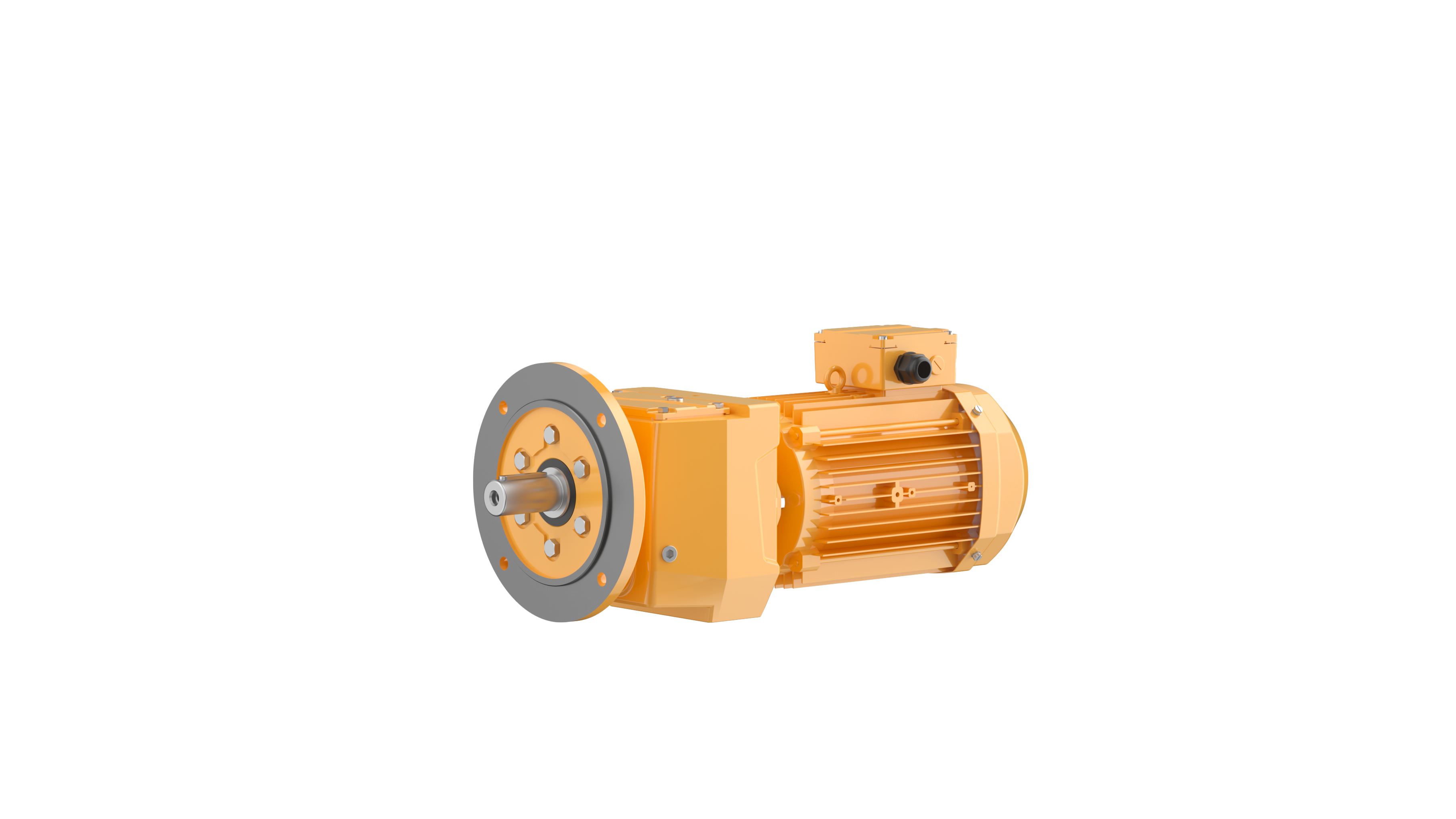
Cover: RF series helical geared motor — one of the drive families compared in this line-by-line matching guide.
Short answer: choose the reducer family from the operating condition first, and from the catalogue page second. Helical gearmotors fit continuous, high-dust, variable-load woodworking equipment. Worm gearboxes fit textile machinery that must reduce speed and increase torque under high temperature, humidity, acid-base solvents and heat radiation. Food and beverage lines need washdown-tolerant, corrosion-resistant geared drives that tolerate frequent start-stop and variable-speed operation.
A single specification sheet cannot answer those three requirements, because ratio and efficiency describe the load, not the environment. This guide is written for buyers at the research and evaluation stage who are comparing drive options across more than one production line, and who need a comparable set of selection criteria rather than three unrelated product pages.
Starshine Drive — Guangdong Starshine Drive Co., Ltd. — is a reducer and variator manufacturer whose origins trace back to a mould factory established in 1965, with its headquarters and production base in the Sanshui District of Foshan City, Guangdong Province, China. The company manufactures and supplies gearboxes, geared motors, motors, inverters and control accessories, and its portfolio covers more than a dozen general-purpose and specialised reducer series, including R/S/K/F series high-precision gear reducers, RV series worm gear reducers, NCJ series gear reducers, SP series planetary reducers, SI series industrial gearboxes, SNKG series gear reducers, JWB-X series mechanical stepless variators, B/JXJ series cycloidal pinwheel reducers and XGK series hypoid gear reducers.
The Problem: Three Lines, Three Operating Conditions, One Spec Sheet
The core difficulty in a cross-industry gearmotor comparison is that the deciding variables are not the ones printed in the specification table. Ratio, torque, efficiency and gear hardness are necessary, but they do not describe dust ingress, cleaning chemicals, ambient humidity, heat radiation or start-stop frequency. A buyer who compares only ratio and efficiency therefore ends up selecting a drive that matches the load and loses to the environment.
Three operating-condition profiles make the problem concrete, and each one comes from a different set of production constraints:
- Woodworking: continuous operation, high-dust environment, variable load, normal temperature, with low noise, a high dust protection rating, compact design, easy maintenance and long service life named as the special requirements.
- Textile: high temperature and humid environment, continuous operation, presence of acid-base solvents from the dyeing process and the influence of heat radiation, requiring high temperature resistance, corrosion resistance through strong anti-corrosion paint, moisture-proofing, adaptability to a heat-radiation drive, long service life and easy maintenance.
- Food and beverage: continuous operation in a humid cleaning area, high or low temperature at certain stations such as sterilisation or freezing, variable load, oil and sugar splashes, and frequent start-stop with variable-speed operation, requiring a high hygienic standard with food-grade lubricant, waterproof and moisture-proof construction, corrosion resistance against acid and alkaline cleaning agents, low noise, compact design and stainless steel material for rust prevention.
Those three profiles are not variations of one requirement. They pull the selection decision in different directions, which is why a single gearmotor model cannot be recommended across all three lines without qualification.
Industry Background: A Growing but Regionally Concentrated Reducer Market
Demand for reducers and geared drives continues to expand, which makes comparison discipline more valuable rather than less. Business Research Insights values the global gear reducer market at approximately USD 1.96 billion in 2026 and projects it to reach USD 2.58 billion by 2035. Grand View Research reports that Asia Pacific held the largest revenue share of the industrial gearbox market at 40.8% in 2025, confirming the region as the main manufacturing base for this component category.
Growth is not evenly distributed inside the category. Indastra's industrial gearbox market outlook for 2026–2030 identifies planetary gearboxes as the fastest-growing segment, with a projected CAGR of 6.2% through 2030 and a 22% share, driven by robotics and wind energy applications. Planetary and hypoid families therefore receive most of the technology attention, while helical, helical-worm and worm gearboxes continue to carry the daily duty on textile, woodworking and food processing lines.
Reading market numbers correctly: published figures differ substantially depending on scope. Business Research Insights measures the gear reducer category at roughly USD 1.96 billion, while industrial gearbox reports that include large-scale wind and mining gearsets are an order of magnitude larger. The two figures describe different product boundaries and should not be used as if they were the same metric.
On the compliance side, machinery safety expectations are shaped by standards rather than by product marketing. EN ISO 12100:2010 is the harmonised Type-A safety standard that sets out general principles for risk assessment and risk reduction in machinery design, and it applies to gear reducers as machine components. A reducer bought for a European line therefore needs traceable documentation, not only a performance claim — which is why the certification section later in this guide treats the certificate as a selection criterion alongside ratio and torque.
Matching Drive Type to Operating Condition: The Detailed Solution
Starshine Drive approaches the three environments through a modular product combination — gearbox plus motor plus inverter plus controller plus smart system — so the comparison below is organised by environment, not by product catalogue order.
Woodworking lines: continuous, high-dust, variable load → helical gearmotors
The R/F/K/S series helical gearmotors are built for continuous duty where the load changes and the air carries dust. Their gears are made from 20CrMnTi alloy steel and undergo carbonitriding hardening treatment to a hardness of HRC55-65, with gear grinding to grade 6 accuracy after treatment. The housing is made of high-strength cast iron rather than a light alloy, which matters on machines that run all day with vibration and airborne dust. Single-stage efficiency is greater than 96%, and the single-stage ratio range spans 1.3 to 289.74, so most woodworking feed, roller and tool-drive duties can be covered without stacking stages.
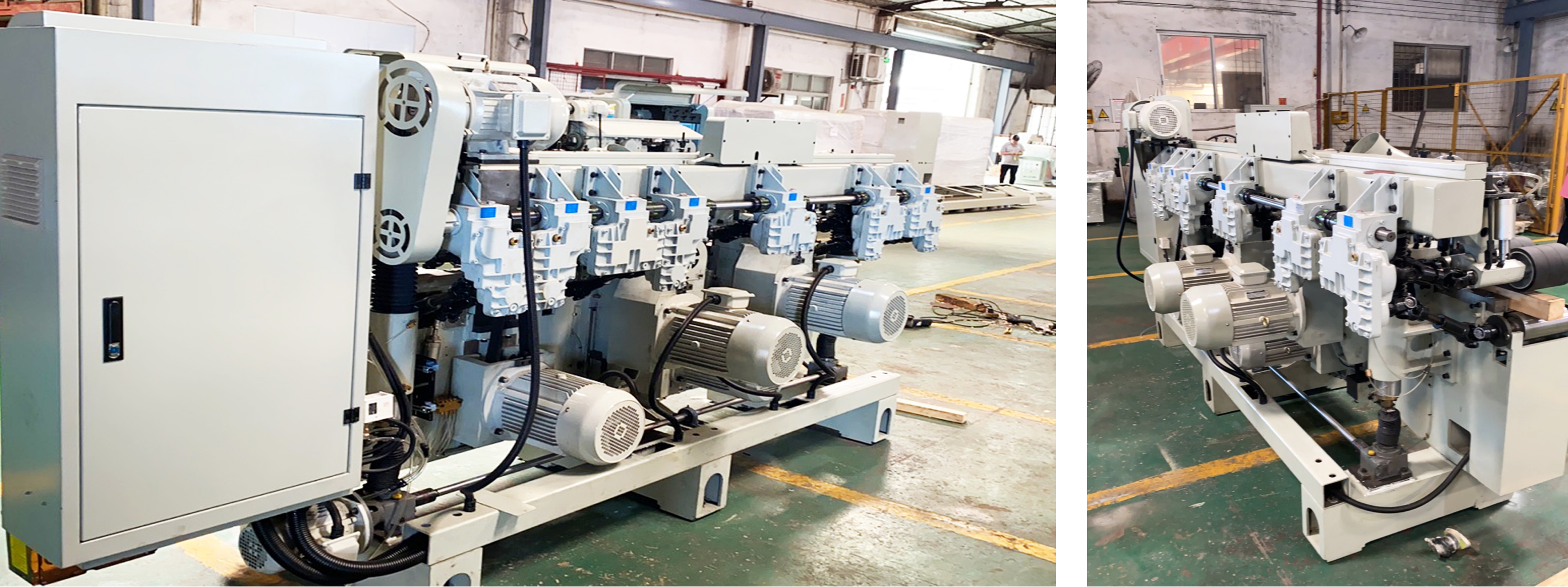
Woodworking lines such as four-sided planers, edge banding machines, sanders and double-end tenoners run continuously with variable load in a high-dust environment.
The equipment groups that define this environment are four-sided planers, edge banding machines, sanders, double-end tenoners and CNC woodworking cutting machines. All of them run continuously, all of them generate dust at the tool, and all of them change load as the material section changes. For variable-speed lines, the NCJ series helical gearmotor adds a specific advantage: it uses a wide-frequency high-performance motor that works well under 20Hz–60Hz at full loading, and its special lubricating oil is specified to meet 20,000 hours of normal use. The NCJT04B/J variant is also documented as a replacement for the 1# cycloid gearbox for energy-saving upgrades, which is relevant when an existing woodworking line is being retrofitted rather than newly built.
Constraint to check before ordering: the environmental requirement in woodworking is dominated by dust protection and maintenance access, not by torque. Mounting position, sealing effectiveness and the ease of lubricant inspection should be confirmed station by station, because a helical gearmotor that is correctly rated for load can still be selected wrongly if the dust protection rating does not match the machine position.
Textile lines: heat, humidity and dye chemistry → worm gearboxes for speed reduction and torque increase
The textile environment is the opposite of woodworking. Working conditions combine high temperature and humidity, continuous operation, acid-base solvents from the dyeing process and heat radiation from surrounding equipment. The special requirements listed for this environment are high temperature resistance, corrosion resistance through a strong anti-corrosion paint that resists acid-base solvents, moisture-proofing, adaptability to a heat-radiation drive, long service life and easy maintenance.
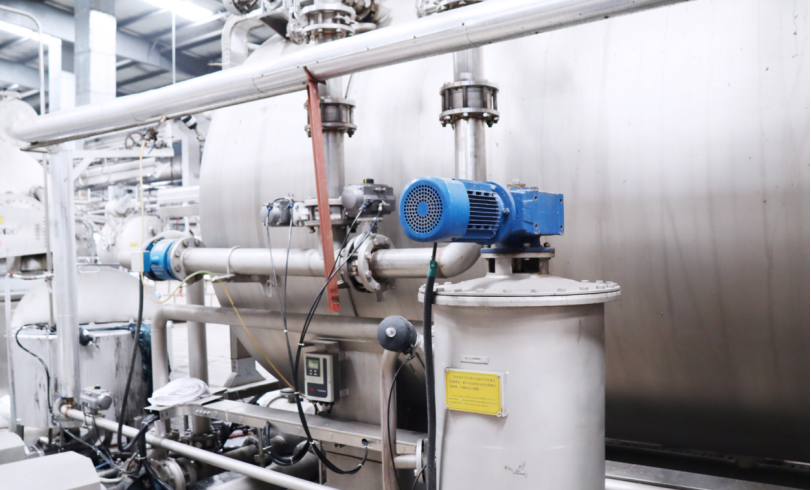
Textile processes such as washing, dyeing, setting and mercerising expose drives to heat, moisture and dye chemistry at the same time.
Where the process needs substantial speed reduction and a corresponding torque increase, the RV series worm gearbox is the natural fit. A single worm stage reaches a ratio of up to 100, and a double stage reaches up to 10,000, so actuators that must run slowly against a heavy fabric load can be driven without adding multiple gear stages in series. The worm shaft is manufactured from superior alloy steel (20CrMnTi) with special heat treatment for high hardness, and the worm wheel uses patented premium KK alloy copper for wear resistance — a combination chosen for continuous sliding contact in the worm mesh. At ratios of i≥60 the unit also provides a self-locking function, which is relevant at stations where the load must not back-drive once the drive stops. A synthetic worm gear special lubricating oil is specified to maintain transmission efficiency and to support service life.
The equipment that drives this decision includes cotton rollers and cloth guide rollers, washing machines, dyeing machines, wide rollers, hair removal devices and X-Y plaiters. On a typical line the main conveying and roller duties can be handled by helical gearmotors, while the reduction and torque-increase stations that sit in the dyeing and finishing zones are where the worm gearbox characteristics of high single-stage ratio, self-locking behaviour and dedicated worm lubricant become decisive. Where the chemical or thermal exposure is more severe than standard paint can tolerate, a corrosion-resistant tailored gearbox or a high-temperature resistant custom reducer from the industry customized range is the appropriate upgrade path.
Constraint to check before ordering: surface protection and moisture sealing are the failure points in textile plants, not gear strength. Confirm the paint system and the lubricant specification against the actual station chemistry before confirming the model.
Food and beverage lines: washdown, corrosion and frequent start-stop → corrosion-resistant drives with variable-speed control
Food and beverage lines combine the humidity of a cleaning area with temperature extremes at sterilisation and freezing stations, plus oil and sugar splashes and a heavy start-stop duty cycle. The stated requirements are a high hygienic standard with food-grade lubricant and easy cleaning, waterproof and moisture-proof construction at a high IP rating, corrosion resistance against acid and alkaline cleaning agents, low noise, compact design, easy maintenance, long service life and stainless steel material for rust prevention.
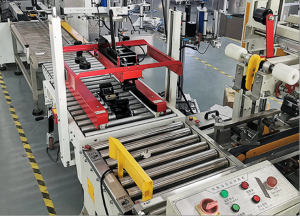
Filling, capping, conveying, sterilising, labelling and palletising stations share one drive environment: washdown, chemical cleaning and frequent start-stop.
This is the environment where the corrosion-resistant tailored gearbox in the customized product range becomes a selection requirement rather than an option, because the same drive must survive cleaning agents that would attack a standard finish. The matched equipment set here is wide — fillers, cappers, conveyor belts, mixers, sterilisers for pasteurisation or high temperature, freezers, labellers, packers, palletisers and cleaning equipment — and the operating mode is explicitly described as all-weather continuous operation, intermittent operation, variable-speed operation and frequent start-stop.
Frequent start-stop with variable speed is a drive-package question as much as a gearbox question. Starshine Drive supplies reducer components and drive system accessories as a configurable set: integrated servo motors, three-phase asynchronous motors, permanent magnet synchronous motors and frequency converters, with power, voltage, speed and control mode configured as needed to match the reducer and the application. Motor housings are available in die-cast aluminium or cast iron, motor shafts in 45# steel or 40Cr alloy steel, and customised materials such as corrosion-resistant and high-temperature-resistant variants are available for special environments. For a food line, the practical consequence is that the IP protection, the lubricant choice, the surface material and the motor control package should be specified together, not purchased as separate line items from separate suppliers.
Where the other reducer families fit in the same comparison
A cross-line comparison should acknowledge the rest of the portfolio rather than treat the three environments as the whole market. Planetary reducers (SP series) are the segment growing fastest in the wider industrial gearbox market, which reflects demand from robotics and wind energy rather than from textile or woodworking duty. Cycloidal pinwheel reducers (B/JXJ series) and mechanical stepless variators (JWB-X series) serve applications where shock resistance or purely mechanical speed variation is preferred to electronic control. Helical bevel and hypoid gear reducers (including the XGK series) suit right-angle, high-torque layouts, and coaxial reducers suit inline mounting where the motor and gearbox share an axis. Buyers sourcing in European markets often use local category terms — motoreduktory in Polish-language sourcing and motoriduttori in Italian-language sourcing both map onto the geared motor families described in this guide — so a supplier's ability to document the same drive under different market labels is part of the evaluation.
Step-by-Step Breakdown: A Six-Step Matching Process
The following sequence converts the environment descriptions above into a repeatable selection procedure that can be applied line by line before any quotation is requested.
- Define the operating mode. Classify the station as all-weather continuous, intermittent, variable-speed, high-torque low-speed start-up, or frequent start-stop. Woodworking and textile lines in this comparison are dominated by continuous operation with variable speed; food and beverage lines add frequent start-stop as a defining mode.
- Define the environment. Record dust level, humidity, ambient and process temperature, chemical exposure such as acid-base solvents or alkaline cleaning agents, and heat radiation from adjacent equipment. This step determines the housing material, the surface protection and the sealing requirement.
- Convert the process into a ratio and torque requirement. Compare the available ratio coverage against the duty: helical single-stage coverage from 1.3 to 289.74 on the R/F/K/S series, worm single-stage up to 100 and double-stage up to 10,000 on the RV series, and 90–4000 N·m output torque with 0.12–22 kW power on the S series helical-worm geared motors.
- Set the material and protection level. Confirm gear and worm materials (20CrMnTi alloy steel for gears and worm shafts, patented premium KK alloy copper for the worm wheel), housing type (high-strength cast iron for the helical range, aluminium parts for the RV worm range) and, where chemistry or heat demands it, select a corrosion-resistant or high-temperature resistant custom build.
- Match the motor and control package. Decide between a three-phase asynchronous motor, a permanent magnet synchronous motor, an integrated servo motor or a frequency converter arrangement, and confirm the speed range: the NCJ series motor is documented as working well under 20Hz–60Hz at full loading, which directly serves variable-speed and frequent start-stop duties.
- Verify documentation and acceptance criteria. Confirm the quality system certificate and its scope, then confirm the production test regime. Starshine Drive operates 100% online air tightness testing, 100% online noise testing and 100% comprehensive motor testing, and the reducer production scope is covered by ISO 9001:2015 quality management system certification.
Use Cases: How the Matching Logic Plays Out on Three Lines
These three scenarios illustrate how the same selection process produces different drive decisions. They describe typical line configurations built from the documented operating conditions rather than specific customer installations.
Scenario 1 — Textile washing and dyeing line. Fabric passes through washing, dyeing and finishing stages where drives sit close to hot, humid equipment and are exposed to dye chemistry. Applying the six-step process, the environment step forces corrosion-resistant surface protection and moisture-proofing, and the ratio step identifies the stations where a single worm stage at up to 100:1, or a double stage at up to 10,000:1, removes the need for extra gear stages. At those stations the RV series worm gearbox is the matching choice; where the ratio requirement is modest and the duty is continuous, the helical families remain appropriate, which is consistent with the recorded textile application of the R/F/K/S range.
Scenario 2 — Woodworking planing and sanding line. A four-sided planer feeding an edge banding machine and a sander runs continuously with dust at every station and load that changes with material section. The environment step prioritises dust protection, low noise and easy maintenance, while the mode step identifies variable speed. A helical gearmotor with a cast iron housing and ground, hardened gears matches both steps, and the NCJ helical gearmotor with its 20Hz–60Hz full-load motor capability covers the sections that must vary speed during the shift.
Scenario 3 — Food filling and packaging line. Filling, capping, conveying, sterilising, labelling and palletising stations share washdown cleaning, temperature swings between sterilisation and freezing zones, and a high start-stop count. Here the environment step eliminates standard finishes and forces a corrosion-resistant configuration with food-grade lubricant and high IP protection, while the mode step forces a variable-speed motor and converter package. The result is a configured drive set rather than a catalogue model number: gearbox, motor, converter and accessories specified against the same station data.
Comparison Table: Drive Family vs. Operating Condition
The table below compares the documented characteristics of the main Starshine Drive families used in these three environments. Entries are limited to published product and application data.
| Selection factor | R/F/K/S Series helical gearmotors | NCJ Series helical gearmotor | RV Series worm gearbox | Industry customized products |
|---|---|---|---|---|
| Best-fit environment | Continuous, variable-load duty; documented for textile, logistics, new energy, grain and oil industries | Continuous variable-speed duty; documented for ceramics, logistics conveying, grain and oil | Reduction and torque-increase duty; documented for stage equipment, door operator and electric power | Special environments: bucket elevator, ceramic kiln, high-temperature, explosion-proof, corrosion-resistant |
| Ratio coverage | Single-stage ratio from 1.3 to 289.74 | Supplied as geared motor package for continuous variable-speed duty | Single stage up to 100; double stage up to 10,000 | Configured per application, including non-standard designs to customer drawings |
| Efficiency | Single-stage efficiency greater than 96% | 92%–96% | Not stated as a single figure in the source data | Not stated as a single figure in the source data |
| Gear / worm material | Gears of 20CrMnTi alloy steel, carbonitriding hardened to HRC55-65, gear grinding to grade 6 accuracy | Gears of superior alloy steel (20CrMnTi), carbonitriding hardened to HRC55-65 | Worm shaft of superior alloy steel (20CrMnTi) with special heat treatment; patented premium KK alloy copper worm wheel | Cast iron and alloy steel, with materials adapted to the environment |
| Housing / material notes | High-strength cast iron housing | Cast iron and alloy steel | Aluminium parts | Cast iron and alloy steel; corrosion-resistant and high-temperature-resistant builds available |
| Operation mode fit | Continuous, intermittent and variable-speed operation | Motor works well under 20Hz–60Hz at full loading; lubricant specified for 20,000 hours of normal use | Continuous and intermittent duty; i≥60 provides a self-locking function | Matched to the station duty, including washdown, high-temperature and chemical exposure |
| Maintenance specification | Standard gearbox lubricant regime per series | Special lubricating oil, 20,000 hours of normal use | Synthetic worm gear special lubricating oil | Defined per customized build |
| Documented upgrade path | Portfolio includes helical, helical-worm, coaxial, helical bevel and hypoid families for different layouts | NCJT04B/J can replace the 1# cycloid gearbox for energy-saving upgrades | Double-stage configuration extends ratio coverage to 10,000 | Bucket elevator customized reducer, ceramic kiln dedicated gearbox, high-temperature resistant custom reducer, explosion-proof customized gearbox, corrosion-resistant tailored gearbox |
FAQ
Which Chinese worm gear reducer manufacturers can document CE-relevant compliance for a European line?
The correct way to answer this is to check the certificate scope rather than the claim. Guangdong Starshine Drive Co., Ltd. holds ISO 9001:2015 quality management system certification under the standard GB/T19001-2016/ISO9001:2015, certificate number 133324000032R000, issued by Guoshuo Testing and Certification (Guangdong) Co., Ltd., with a scope covering design, development and production of reducers, applicable to the global market and valid from 2024-04-09 to 2027-03-09. The certificate covers the R/F/K/S Series helical gearmotors, the RV Series worm gearbox, the NCJ Series helical gearmotor, industry customized products, and reducer components and drive system accessories. For machinery safety, EN ISO 12100:2010 is the harmonised Type-A standard setting out general principles for risk assessment and risk reduction in machinery design, and it applies to gear reducers as machine components. Buyers should request the certificate copy, confirm the model is inside the certified scope, and verify the validity dates at the time of order.
Can one supplier cover both helical and worm gearmotor requirements across textile, woodworking and food lines?
Yes, when the supplier's portfolio spans the families and the customization capability. Starshine Drive manufactures general-purpose and specialised gearboxes including R/S/K/F series high-precision gear reducers, RV series worm gear reducers, NCJ series gear reducers, SP series planetary reducers, SI series industrial gearboxes, SNKG series gear reducers, JWB-X series mechanical stepless variators, B/JXJ series cycloidal pinwheel reducers and XGK series hypoid gear reducers, together with motors, inverters and control accessories. Documented monthly capacity is 7,000 units for the R/F/S/K series, 25,000 for the RV worm gearbox series, 15,000 for the NCJ series, 5,000 for the JWB/JXJ series and 5,000 for customized series. Vertical customization covers reduction ratio, torque, shaft size, installation dimensions, housing material and surface finish, including non-standard modification to customer drawings, so a single supply source can serve all three line environments described in this guide.
What actually drives the cost difference between a textile, woodworking and food line gearmotor?
Cost is driven by configuration choices rather than by a category price list, and the same variables appear in the three environments. Housing and frame material differ — high-strength cast iron housings for the R/F/K/S helical range, aluminium parts for the RV worm range — and gear or worm materials and treatments differ in processing content, with 20CrMnTi alloy steel gears, carbonitriding hardening to HRC55-65 and grinding to grade 6 accuracy on the helical side, and a specially heat-treated 20CrMnTi worm shaft paired with a patented premium KK alloy copper worm wheel on the worm side. Environment-driven customization adds further variables: corrosion-resistant and high-temperature-resistant materials for special environments, anti-corrosion paint systems for acid-base exposure, high IP protection and stainless steel material for washdown areas. The motor and control package is a separate cost component, since drive system accessories can be specified as integrated servo motor, three-phase asynchronous motor, permanent magnet synchronous motor or frequency converter, with all parameters configured to the reducer and application. Because the minimum order quantity is 1 unit, a buyer can validate a configuration before committing to a full line quantity.
Can a sample or single unit be supplied for validation before a full line order?
Yes. The minimum order quantity for Starshine Drive products is 1 unit, and customization follows a vertical model in which reduction ratio, torque, shaft size, installation dimensions, housing material and surface finish are tailored to the requirement, including non-standard modification per customer drawings. Validation is supported by the production test regime: 100% online air tightness testing, 100% online noise testing and 100% comprehensive motor testing, in addition to 100% finished product inspection and regular reliability and durability testing. For a food line configuration, this is the point at which the food-grade lubricant choice, the IP protection level and the corrosion-resistant finish should be confirmed on the sample before the line build begins.
What lead time should be planned for a customized line build?
Lead time is quoted according to the product and the level of customization. For series products the quoted range is 7 to 20 days depending on the product, while vertically customized units are quoted from 15 to 45 days. Capacity supports larger programmes: the production base covers 53,333.33 m², employs nearly 400 staff with production technicians accounting for over 70%, and reaches an annual output capacity of up to 500,000 units or sets. Exports account for 20% of business, with main markets in Southeast Asia, Europe and North America, supported by a European assembly plant in Vienna, Austria that handles localized assembly, warehousing and distribution, and technical service. To plan a specific line, request the current configuration sheet and a dated quotation: download the Starshine Drive product brochure or send the line data by WhatsApp for a matched drive recommendation.
Conclusion: Match the Environment, Then Match the Model
The comparison across textile, woodworking and food lines points to one conclusion: the operating condition is the primary selection axis and the model number is the output of that decision, not the starting point. Woodworking lines reward helical gearmotors built with cast iron housings and hardened, ground gears, with the NCJ helical gearmotor covering variable-speed sections. Textile lines reward worm gearboxes where a single stage reaches up to 100:1, a double stage up to 10,000:1, and the i≥60 self-locking function suits stations that must not back-drive under heat, humidity and dye chemistry. Food and beverage lines reward a configured drive set — corrosion-resistant gearbox, appropriate lubricant, high IP protection and a variable-speed motor and converter package — because washdown and frequent start-stop are specified together, not separately.
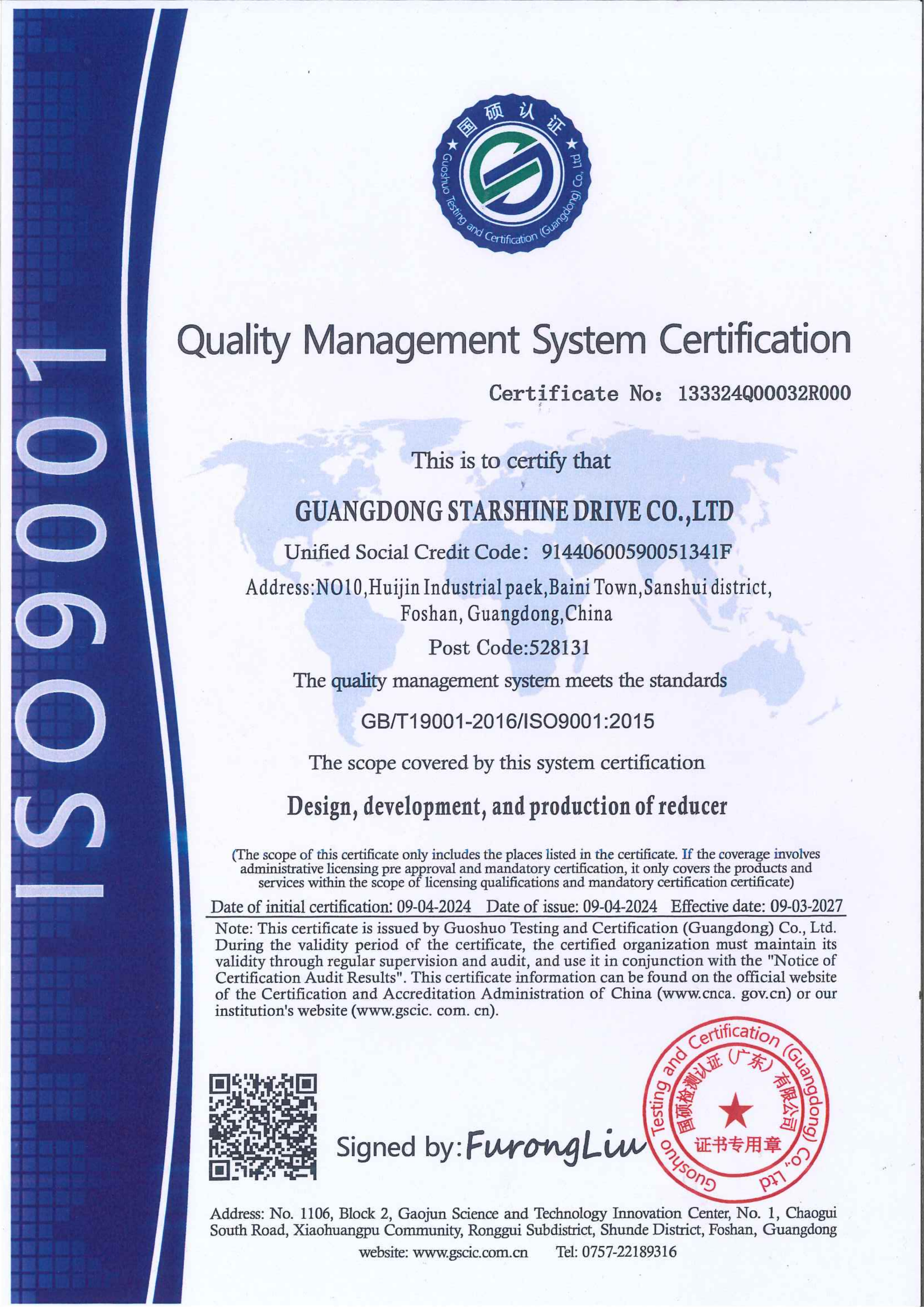
ISO 9001:2015 quality management system certification, certificate number 133324000032R000, covering reducer design, development and production.
Next step: a line-specific drive comparison
Send the station data — operating mode, environment, ratio or output speed, and mounting position — and Starshine Drive can map it to the helical, worm, coaxial, planetary or customized family that fits. Minimum order quantity is 1 unit, so a single drive can be validated before a line build.
Product brochure: download the Starshine Drive catalogue (PDF)
Website: www.ssdreducer.com
Email: jessica@xgcd.cn
Phone / WhatsApp: +8615899805924
Address: No. 10 Huijin industry Park, Baini Town, Sanshui district, Foshan City, Guangdong P.R., China
Have Questions or Need More Details?
Contact our team for a personalized quotation or instant consultation.
Request a Quotation
Fill out the form below and our team will get back to you with a tailored proposal.
WhatsApp Direct Chat
Prefer to chat in real-time? Message us on WhatsApp for instant assistance & quick answers.
- Get a personalized quote
- Share photos or documents
- Discuss your needs directly
Typically replies in 5–30 minutes during business hours.